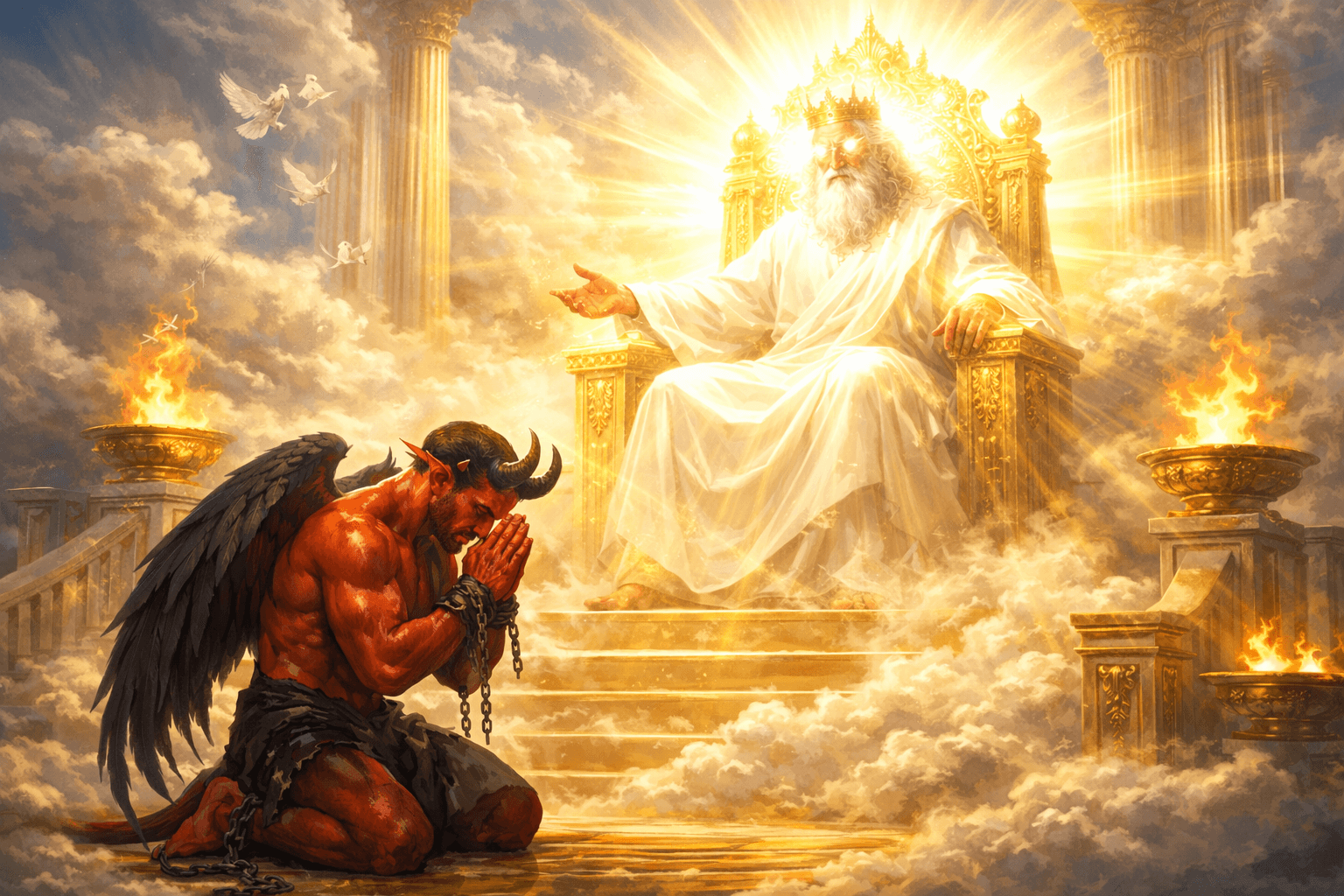

This question touches the deepest parts of theology, justice, mercy, and free will: What if the Devil asked God for forgiveness? Would God forgive him? On the surface, it sounds simple – after all, God is loving and merciful.
But when we look deeper into Scripture and Christian belief, the answer becomes much more complex.
God’s Nature: Always Willing to Forgive
The Bible consistently shows that God delights in mercy. Verses like Ezekiel 18:23 tell us that God takes no pleasure in anyone’s destruction, and 1 John 1:9 promises forgiveness to those who genuinely repent.
From this perspective, God’s forgiveness is not limited by power or emotion. He can forgive anyone.
So, in theory, God’s mercy is great enough to forgive even the Devil.
But forgiveness isn’t just about asking.
The Real Issue: Repentance, Not Permission
Biblical forgiveness requires true repentance, a genuine turning away from sin, humility, and submission to God. This is where the Devil’s situation becomes different from that of humans.
According to Scripture, Satan’s rebellion was not a moment of weakness or ignorance. It was a deliberate, informed choice.
Passages like Isaiah 14:12–15 and Ezekiel 28:12–17 (often understood symbolically) describe pride, self-exaltation, and a desire to overthrow God’s authority. Satan did not fall because he didn’t know better, he fell because he refused to submit.
The Bible never shows Satan seeking repentance. Instead, it describes him as continuing in rebellion, deception, and opposition to God (Revelation 12:9, 1 Peter 5:8).
Angels and Humans Are Not the Same
Another key difference lies in free will and consequence. Humans sin in weakness, ignorance, fear, and brokenness, and God provided redemption for us through Jesus Christ.
Angels, however, are described as beings who existed in God’s presence with full awareness of His glory.
Hebrews 2:16 points out something important: Jesus did not come to redeem angels, but humans. This suggests that the opportunity for redemption was uniquely designed for humanity, not fallen angels.
In other words, the Devil’s choice was final not because God is cruel, but because it was made with complete knowledge and without deception.
Could the Devil Even Want Forgiveness?
This is an uncomfortable but honest question. Forgiveness requires humility. It requires surrender. It requires admitting God is right and you are wrong.
The Bible portrays Satan as incapable of this, not because God refuses him, but because pride defines him. His desire is not reconciliation, but control, imitation, and opposition.
Even when Scripture speaks of his end, there is no hint of regret, only resistance (Revelation 20:10).
So the issue may not be “Would God forgive Satan?” but rather “Would Satan ever truly repent?”
God’s Justice Still Matters
God’s mercy does not cancel His justice. Evil that fully understands itself and still chooses rebellion must be judged. Forgiveness does not mean the absence of accountability.
Scripture consistently shows that God is patient, but not permissive.
The Devil’s final judgment is described not as revenge, but as the necessary end of unrepentant evil.
What This Means for Us
This question isn’t really about the Devil, it’s about us.
It reminds us that:
-
Forgiveness is always available while repentance is possible
-
Pride hardens the heart more than sin itself
-
Knowing God is not the same as submitting to Him
Unlike Satan, humans are still in the season of grace. Our failures are not final. Our repentance matters. Our humility opens the door to mercy.
Conclusion
If the Devil asked God for forgiveness, but without true repentance – nothing would change. And if true repentance were possible, it would require a complete surrender that Scripture shows he will never choose.
God’s mercy is limitless – but it is never forced.
And the most important truth is this: what Satan rejected is still freely offered to you and i.






Leave a Reply